Decision-making and AI


This year, I spent time teaching my students to understand and think critically about artificial intelligence. This involved teaching students about how AI works, how it is developed (with a focus on workers' rights, copyright and privacy issues), how AI affects our learning and mental health, why generative AI can hallucinate, and how it can demonstrate bias. After exploring these topics, students need to spend time considering when AI is appropriate and inappropriate, particularly in a classroom setting. This requires a classroom conversation, but first I chose to have students reflect using the project that is shown below.
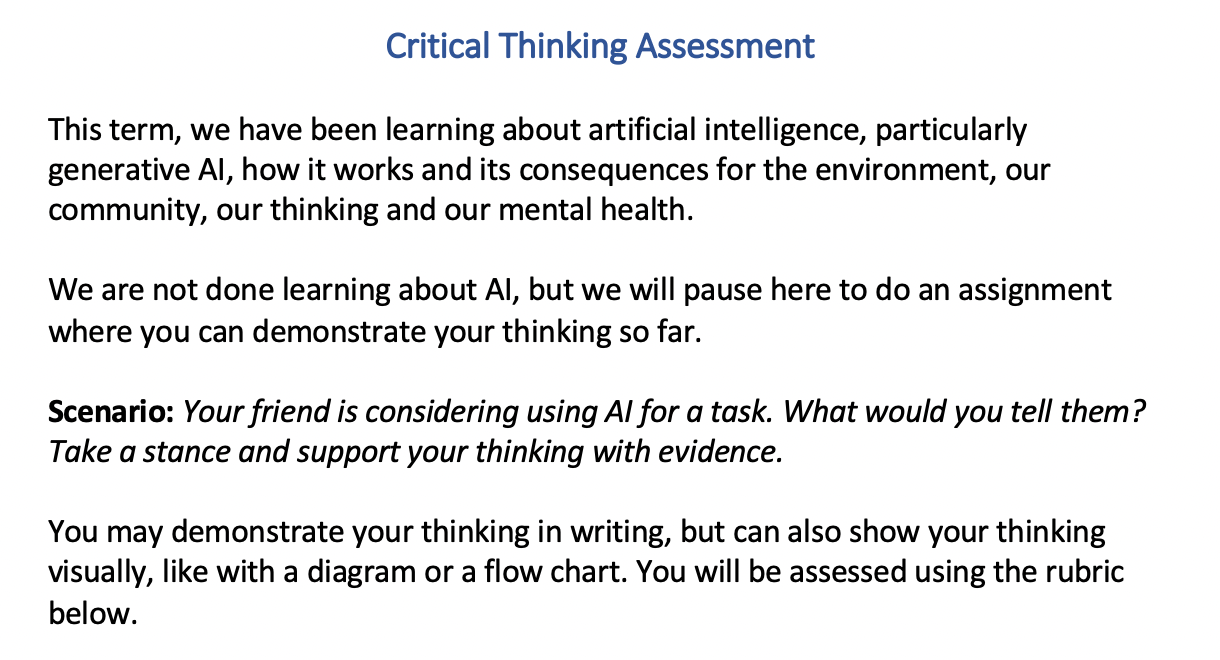
When I ask students to give their friend advice about AI, I kept the scenario purposely vague. I wanted students to think about situations that are relevant for them and more clearly defining the task their friend wants to accomplish might limit my students' thinking. A lot of students ended up deciding that the appropriateness of AI depends on the given situation and spent time outlining when they would find it acceptable and when they would advise against it. This type of decision-making, particularly when supported by reasoning and evidence, is what I was hoping to see. Students' opinions didn't always match my own, but that was never the point. I wanted them to make well-reasoned decisions regarding AI, using a solid understanding of how AI works, its capabilities and its drawbacks.
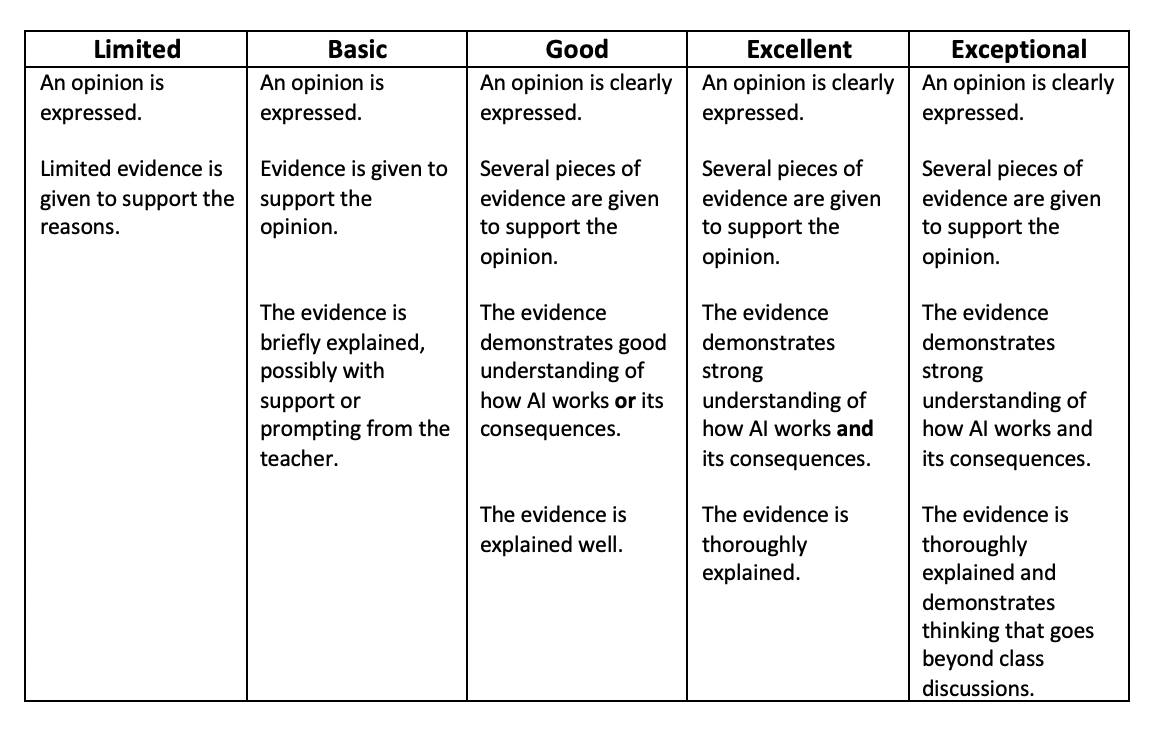
I used the above rubric to assess students' critical thinking skills, particularly their ability to express an opinion and support it with detailed evidence. How students respond is flexible, so the rubric could be applied to assess a written response, a diagram, a visual representation, an oral explanation or some combination. This allows for some differentiation for a variety of learners, allowing students to participate more fully.
The next step after this project is to have a conversation with students establishing the classroom norms related to the use of AI. One way of approaching this conversation is to start with students making a list of ways students could use AI in class or for class. Then as a group the class could discuss and establish which uses are acceptable and which uses are not acceptable, of course grounding this discussion in the school's plagiarism policy.
I will be honest that my interest in having AI play a role in my students' learning is limited. I am skeptical that AI is a good research tool and the ethical issues surrounding its use and development give me pause. At this point, research hasn't demonstrated that it is beneficial for students' learning, and I don't think that tech companies have put appropriate guardrails in place to protect young people who use the technology.
I won't be encouraging the use of AI within my English classroom, but I do want students to be equipped to make choices for themselves. Hopefully in exploring how this technology works and how it impacts us and our information landscape, students are better able to decide how or whether to engage with generative AI in their own lives.