Queer Mythology


I love Greek mythology. When I was a kid, I spent countless hours reading myths and legends. As a teacher, I have kept up this love with lots of mythology books in my classroom library, and expanding to the Rick Riordan Presents imprint. While some of these books have offered hints of queer representation, Queer Mythology: Epic Legends from Around the World, by Guido A. Sanchez, more extensively explores the rich global mythology that focuses on 2SLGBTQIA+ gods, demi-gods, and heroes. The book features twenty stories from different cultures, each with beautiful art by James Fenner to represent each myth.
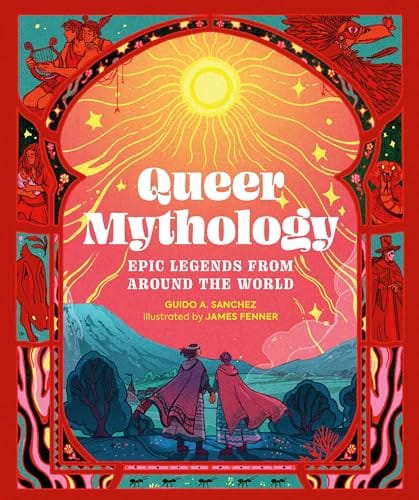
The stories are sometimes familiar, but also featured tales that I had never heard before. The author tells the story of Greek goddess Athena, who gained wisdom after two lesbian relationships. Also from Greek mythology comes stories about Hermes, Achilles and Patroclus, and Apollo. Norse god Loki also makes an appearance, who famously defied boundaries, particularly gender boundaries, in some well-known myths.
Other less well-known stories are present (or at least less well-known to me). This includes a Chilean folktale about Florinda, a girl who takes on the role of prince and in some versions eventually transforms into a man. The Hawaiian story of Lono and Kapa’ihi offers a queer love story about living your truth. Other stories include the story of Tu’er Shen, a rabbit god from China who protects queer people, Ghede Nibo, an extravagant diety from Haiti, Mawu-Lisa, who is part of a creation story from the Dahomean religion in Benin, Fet-Fruner, a Romanian folktale that affirms the character’s gender transition, and many more.
Each story focuses on a lesson that the main character learns, but the overarching lesson is probably more important to note here. The sheer volume and variety of queer gods, demi-gods and heroes from around the world teaches that queer people in society have a long history. While some people have sought to erase queer stories, both in the past and in contemporary society, queer identities have a long tradition in many cultures. As the author notes, while language and labels might have changed over time, queer people have always existed, as these stories demonstrate. I hope that some of my students can see themselves represented in these myths and know that their identities are part of long-lasting cultural traditions.